The Full Story of Bluejack National: How an Abandoned Course Became Tiger Woods' Island of Luxury in Rural Montgomery County
Drive into rural Montgomery County and you would never expect it: a private world of Tiger Woods golf, custom estates, and a 150-foot water slide. The full story of how Bluejack National came to be, from an abandoned course to an island of luxury.
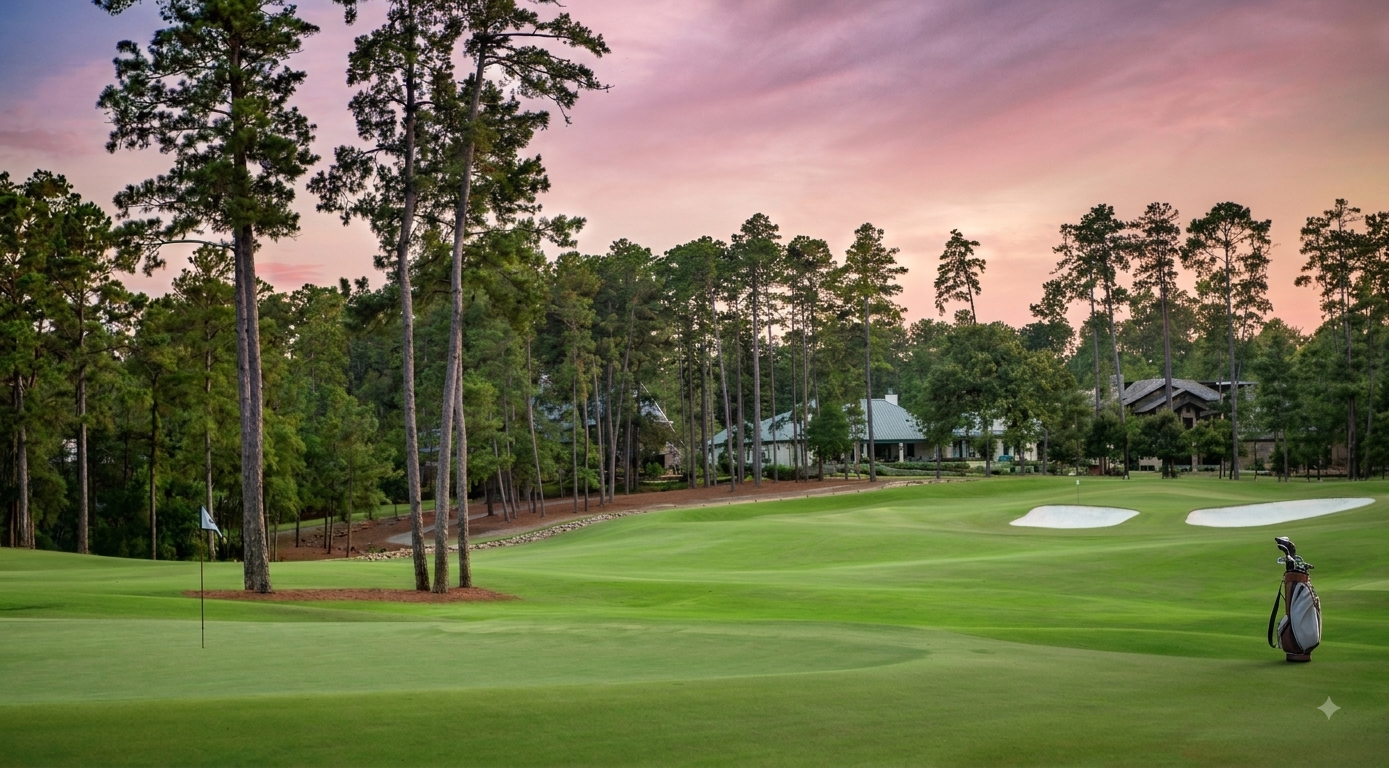
Drive northwest out of Houston on FM 1486, past ranch land and rolling pasture and the tall pines of rural Montgomery County, and you would have no reason to expect what sits behind the gate. The land flattens and sprawls out here the way most of the Houston region does. Then, near the little town of Montgomery, the ground begins to move. Hills rise, sandy and pine-covered, and the terrain starts to look less like Texas and more like the sandhills of the Carolinas or the pine country of Georgia. Behind an unforgettable gate is Bluejack National, a private world of Tiger Woods golf, custom estates, a 150-foot water slide, and a luxury spa, all dropped into the middle of the rural East Texas countryside. It is one of the most remarkable places in Montgomery County, and the story of how it came to be is even better than the golf.
The land before Bluejack: a dreamer, a rejection, and an abandoned course
Long before Bluejack, this ground held a different dream. In the mid-1980s, a Texas businessman named Thomas Blake set out to build a golf course on the property, and the legend behind it is almost too good to be true. As the story is told, Blake wanted to build his own version of Augusta National in Texas after he was denied membership at the real Augusta. If he could not get into the most exclusive club in golf, he would build something like it on his own land in the piney woods north of Houston.
Blake's course became Blaketree National Golf Club. The original design was begun by the celebrated architects Bill Coore and Ben Crenshaw, but the project became troubled, the architects moved on, and Blake himself saw it through to completion. The course opened but never became the destination Blake dreamed of, and it eventually closed in 2005. For nearly a decade after that, the property sat quiet and vacant, its mature oaks and pines growing tall over a golf course slowly returning to the forest, its rolling sandy hills waiting for someone to see what they could be.
The vision: how Bluejack came to be
The someone was Beacon Land Development. As the story goes, one of the people who would become central to Bluejack first heard about this abandoned course north of Houston while traveling in Cabo in the years after the 2008 financial crisis. Word of the property and its unusual, beautiful land spread among people who understood golf and real estate, and what they saw was rare. In a flat, flood-prone region, here were rolling hills, sandy soil, and a mature canopy of hardwoods and pines that looked nothing like the rest of the Houston area.
In 2014, Beacon Land Development, guided by founders Michael Abbott and Casey Paulson, purchased the roughly 755 to 767-acre site and began to turn the vision into reality. Their philosophy was twofold: deliver the finest luxury experience in golf, and build it around families rather than golf alone. Fort Worth investor Andy Mitchell, through Lantern Capital Partners, became a key figure and co-chair of the community. Bluejack National was planned from the start as a premier private club and residential community rooted in creating a great experience for the whole family, not just the single-digit handicapper.
There is a moment from the early days that captures the spirit of the place. At an event soon after the group acquired the property, the son of the original developer, Tom Blake Jr., approached one of the new owners. He asked, half-joking and emotional, whether he had died, because he could not believe the glorious golf course his father had promised back in the 1980s was finally being built. He said it was as if he had reached heaven and found his dad showing off the course he always swore he would build. The dream that died in 2005 was coming back to life.
Getting Tiger: the first Woods design in America
Then Beacon made the move that put Bluejack on the national map. They hired Tiger Woods and his firm, working with design partner Beau Welling, to build a brand-new golf course on the site. This was a landmark: Bluejack National would be the first golf course Tiger Woods ever designed in the United States. For a project in rural Montgomery County, it was an extraordinary coup.
Woods and Welling broke ground in early 2015, with construction handled by Medalist Golf. Woods was deeply and personally involved in the design, walking the property and shaping a layout meant to be both a genuine championship test and, above all, fun to play. When he first saw the land, he was struck by how little it resembled what people picture when they think of Houston. The facility opened in phases through late 2015 and into 2016, and the golf world took notice immediately. Bluejack National won Golf Digest's Best New Private Course for the year it opened, and it has been climbing rankings ever since. Golfweek has rated it the number one residential golf course in Texas and among the top twenty in the entire nation.
The golf course: 18 signature holes and a whole lot of fun
A design built on playability
What makes the Bluejack course special is a philosophy that runs against the grain of what a superstar might be expected to build. Rather than a brutal, punishing test designed to humble average golfers, Woods created a course that is wildly playable and genuinely fun for every skill level, while still challenging the best players through its greens. It stretches to a serious 7,552 yards from the back tees at par 72, but from the appropriate tees it is a joy.
The signature features tell the story. There is no rough at all. Instead, wall-to-wall Zeon Zoysia fairways, a cutting-edge turf developed by a Texas firm, flow into tightly mown surrounds, so a wayward shot leaves you a creative recovery rather than a lost ball. The fairways are generous and wide. The challenge lives in the greens, saucer-like putting surfaces with subtle tilts and tight, contoured surrounds, framed by gorgeous, Fazio-inspired, tight-lipped bunkers. Woods used mounding around the greens to give the average player safe routes to the hole while still demanding precision from the expert trying to attack a tucked pin. It is the rare course a ten-handicapper and a scratch player can both love in the same round.
The unforgettable 12th
The club likes to say it has 18 signature holes, but one stands above the rest: the downhill par-3 12th. It is a clear homage to the famous 12th at Augusta National, one of Tiger's favorite holes at the course where he has won multiple Masters. The shot plays downhill over water to a shallow, diagonal green backed by bunkers, and unlike Augusta's version, the front bunker is left out and the water is brought closer to the putting surface, which somehow makes it even more nerve-racking. The green slopes hard from left to right, so even a shot that finds the surface leaves a tricky putt. Bail out too cautiously and you face a delicate chip; hit it a touch too firm and the green can shed your ball toward the lake. On this hole, par feels like a small victory.
Other holes reward a closer look. The par-5 2nd is another Augusta tribute with a winged green complex and strategic bunkering. The short, driveable par-4 8th is the kind of hole where a 2 and an 8 are both on the table. The reachable par-5 13th features a wild green with a bowl in the middle that splits it into tiers. Throughout, the course offers the variety and balance that separate a good design from a memorable one.
The Bluejack experience
Then there is everything around the golf, which is where Bluejack's personality shines. The on-course comfort stations are the stuff of legend. There is a fruit stand on the front nine, and near the 12th tee a jerky shack with a cook grilling barbecue and brisket, so you can eat smoked meat before the scariest shot on the course. The old Blake Cottage at the 6th, a shady house left over from the original property, sits stocked with snacks and drinks. The club runs an all-inclusive model, so nothing is nickel-and-dimed, and the signature drink, the Jackhammer, has a devoted following. Caddies are part of the experience, and when the course bites you with one of its slopes, you will hear the local phrase: you just got Bluejacked. Play here long enough and someone will tell you golfers occasionally play barefoot on the Zoysia, which tells you everything about the vibe.
The Playgrounds: Tiger's childhood, reborn
One of the most beloved features at Bluejack is not the championship course at all. It is a 10-hole, par-3 short course called The Playgrounds, and the idea came straight from Tiger Woods' own childhood. Growing up in Southern California, Woods used to practice at a neighborhood park, and at night, under the ambient glow of streetlights, he and his friends would invent games, hitting balls over trees, around the jungle gym, and through an old tire. The Playgrounds captures that spirit of pure, unstructured fun. It is fully lit and stays open until midnight, which in the brutal Texas summer means families can play golf together in the cool of the evening long after the big course has gone dark. It is playable for a five-year-old and delightful for a scratch player, which is the whole point.
The Fort and the family concept
If the golf put Bluejack on the map, the family concept is what makes it a community rather than just a club. The centerpiece of that idea is The Fort, an amenity complex so ambitious it won Golf Inc's Amenity of the Year and has been called the world's coolest hangout. It was built on a simple premise: the kids and grandkids should never want to leave.
Outside, The Fort offers two resort-style swimming pools including a lagoon pool, a full water park, and a 150-foot water slide. There is a mini-Fenway Park replica baseball field, complete with its own miniature Green Monster wall, where families play Wiffle ball. There is an events field with a football goalpost, a basketball court, pickleball courts, fire pits, and a lake for canoeing and fishing. Move inside and it keeps going: bowling lanes, ping pong, a media room, a game room stocked with classic and current video games, an arts and crafts and pottery room, a burger grill and bar, and an ice cream station. It is, by design, a place where every member of the family finds something regardless of age or interest.
The Sanctuary, The Porch, and the rest of the world within the gate
Bluejack has kept building. The Sanctuary is its spa and wellness center, a beautiful facility of roughly 12,000-plus square feet set among a grove of pines. It offers massages, facials, body treatments, and beauty services, with on-staff barbers and manicurists, elegant men's and women's lounges, hot tubs and plunge pools, steam rooms and dry saunas, a lap pool, and fitness offerings. In the Texas heat, going from the pool or the courts into a cold plunge and then a sauna is one of the most popular routines at the club.
Dining and gathering center on The Porch, the resort-style clubhouse where the community comes together for meals, celebrations, and events, complemented by The Place, a retail and restaurant center, and a dedicated tennis courtyard. Woven through all of it are roughly 35 acres of stocked fishing lakes and about seven miles of hiking, biking, and running trails that link the amenities together. A large new central clubhouse has been in the works to anchor the next phase, remarkable given how much the community accomplished without one.
The neighborhood: living inside Bluejack
Bluejack is, at its heart, a place to live, and the residential side is as thoughtfully designed as the golf. The community is deliberately small and exclusive, planned to be limited to roughly 420 residences and about 550 memberships, which keeps it intimate and protects the experience.
The homes come in several distinct forms, most built by the in-house Bluejack Builders with a turnkey, move-in-ready philosophy. Custom Estates are the largest and grandest, elegant residences on generous homesites with gourmet kitchens, outdoor living areas, and finishes to match. Cottages and Cabins are charming, smaller homes offered in intimate enclaves that share village greens and sit close to the club core. The Lake Villas are cozy four-bedroom homes clustered along stocked bass lakes, a short walk from The Fort, ideal for families with kids and grandkids. The Sunday Homes sit along the 10th hole and Bluejack Creek with expansive porches made for the relaxed pace of the place. The Retreats are wellness-focused homes positioned near The Sanctuary. And Member Suites offer a lock-and-leave option for those who want a footprint without a full house. Architecturally, the community runs from farmhouse and traditional to craftsman and contemporary, all blended into the natural pine landscape.
Pricing reflects the exclusivity. In recent years, homes have generally ranged from around the high six figures and low millions for villas and cottages up toward $3.5 million and beyond for the largest custom estates, with lakefront villas often landing in the low seven figures. Because so much of the inventory is custom and the community is small, availability is limited and pricing moves with the market, so the real number always comes down to what is actually available at a given moment.
Membership: what it takes to belong
Membership at Bluejack is a serious commitment, in keeping with its standing. Based on widely reported third-party figures, the initiation fee has generally been cited in the range of about $100,000 to $150,000, with a commonly referenced figure around $105,000 for full golf access, and annual dues frequently reported near $15,000 a year, or roughly $1,250 a month. The club offers several membership categories, including Full Golf, Sports, Social, Family, and a discounted Junior-Executive tier for younger members, and it runs on an all-inclusive model, so dues cover use of the amenities tied to your membership rather than charging piecemeal. Payment plans have been available to spread initiation over time. Notably, membership does not strictly require owning a home on site, though buyers often receive bundled arrangements. The club emphasizes walking and a no-tee-times, drop-in culture, and the average member handicap has reportedly hovered around a 7. These figures come from public and third-party sources and shift over time, so anyone serious should confirm current terms directly with the club.
An island of luxury in rural Montgomery County
Step back and the most striking thing about Bluejack National is its setting. This is not a club carved into an established affluent suburb. It sits out in the rural piney woods of Montgomery County, off FM 1486 near the town of Montgomery, roughly 50 miles and about an hour from downtown Houston, surrounded by countryside rather than subdivisions. And that is exactly the point. Bluejack is a self-contained world of the highest-end golf, resort amenities, wellness, and custom homes, dropped like an island into the middle of the rural landscape, apart from the sprawl and pace of the suburbs to the south.
That contrast is its magic. You leave the ranch land and the pine forest, pass through the gate, and enter a curated luxury environment that feels like a private resort you happen to live in. The unusual rolling, sandy terrain that fooled Tiger Woods into thinking he was somewhere other than Houston gives the whole place a sense of being elsewhere entirely. In a county that is one of the fastest-growing in America, Bluejack occupies a rare niche: exclusive, intimate, and deliberately removed. The concept has proven so compelling that the same team has since expanded the Bluejack brand north to the Fort Worth area with a second community and Tiger Woods course, but the original in Montgomery County remains the one that started it all.
Where The Keegan Group comes in
Bluejack National is one of the most distinctive communities in all of Montgomery County, and buying or selling a home inside it is a specialized undertaking. Value here is shaped by the membership structure, the home type and enclave, the scarcity of inventory in a community capped at a few hundred residences, and the lifestyle that makes it what it is. Understanding how those pieces fit together is exactly the kind of local knowledge that protects a buyer or a seller at this level.
That is what we do. We know Montgomery County and the communities that define it, from Bluejack and Bentwater to Carlton Woods and the villages of The Woodlands, and we bring careful, informed representation to every one of them. If you are considering buying into Bluejack National or selling a home there, we offer a complimentary professional valuation and a straight, knowledgeable conversation about the community and the market around it.
Before real estate, we built a company that negotiated with Fortune 500 clients like Huntsman, Owens Corning, and Baker Hughes, and we bring that same standard to representing you in Montgomery County's most exclusive addresses.
Call or text 713-303-5039.
The Keegan Group | Montgomery County, Texas / Residential · Commercial · Land · Investment · Property Tax Consulting.
Ready to Discuss Your Needs?
Whether you're locally upgrading, relocating to the area, or expanding your business or investment portfolio, we're here to guide you with competence and precision.
Call or Text: 713-303-5039