Buying REO and Bank-Owned Properties: The Investor Playbook for Flips and Rentals
Bank-owned properties trade differently and reward investors who know how to work them. Why REO beats the auction route, how it pairs with DSCR financing, and why access is the real barrier.

Most investors chasing deals in Montgomery County are fighting over the same listings everyone else sees. Meanwhile there is a category of property that trades differently, prices differently, and rewards people who know how to work it: real estate owned inventory, better known as REO. These are the homes a lender took back through foreclosure and now carries on its books. Here is why they are a genuine opportunity for both fix-and-flip and buy-and-hold investors, and what makes them different to transact.
What REO actually is
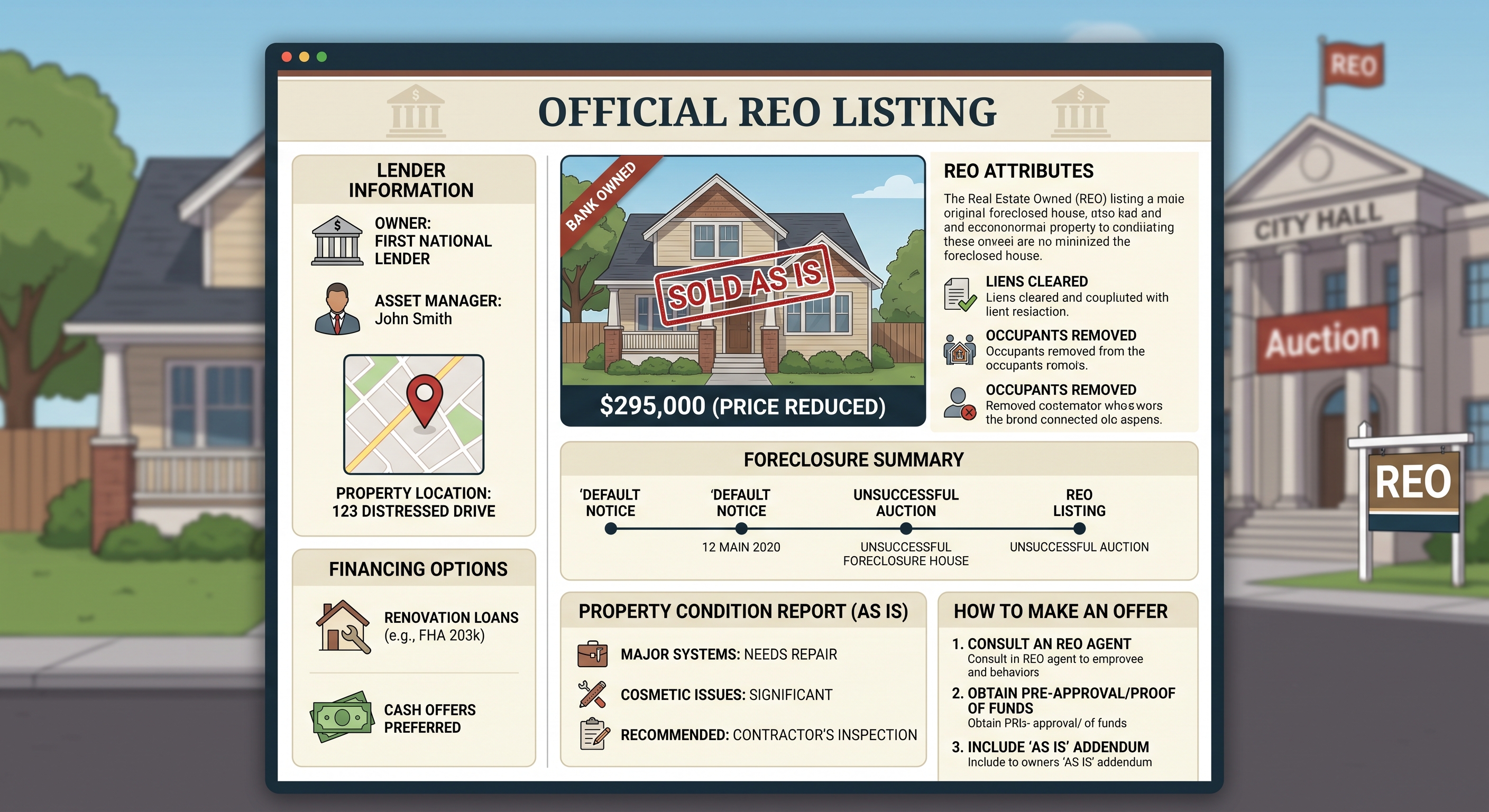
When a property goes through foreclosure and does not sell at auction, it reverts to the lender. At that point it becomes REO, an asset the bank owns and very much does not want. Banks are not in the business of holding houses. Every month a property sits, they carry taxes, insurance, maintenance, and a nonperforming asset on the balance sheet.
That motivation is the entire opportunity. You are negotiating with an institution that wants the asset gone, not with a homeowner who is emotionally attached to the kitchen they remodeled.
Why REO beats the auction route
Investors often lump REO in with foreclosure auctions, and they are very different animals.
At a courthouse auction you typically buy sight unseen, take the property with whatever liens survive, pay cash immediately, and get no title insurance and no inspection. It is a high-risk, high-expertise game.
REO is a normal transaction. The property is listed, you can walk it, you can inspect it, you close through a title company with title insurance, and the lender has generally cleared the liens and evicted any occupants. You get the discount that comes from a motivated institutional seller without the landmines of an auction.
The tradeoff is that REO is sold as is. The bank will rarely make repairs and often will not fill out a seller's disclosure, because the bank never lived there and genuinely does not know the history. That is precisely why your own inspection matters so much, and why the option period is not a formality on these deals.
The fix-and-flip case
REO properties are frequently distressed, sometimes badly. Deferred maintenance, damage, dated everything. That is the point. In flipping, you make your money on the buy, and a property priced to reflect its condition is where margin comes from.
The discipline that separates profitable flips from expensive lessons is unglamorous. Know your after-repair value from real comparable sales, not optimism. Get a genuine contractor scope before you commit, not a napkin estimate. Build a contingency into the rehab budget, because these homes hide surprises. Understand your carrying costs, since every month of holding eats margin. And be honest about the condition, especially foundation, roof, and mechanicals, which is where flips go from profitable to painful.
Our area supports this well. Across Conroe, Willis, Magnolia, Spring, and the older pockets of the county, there is genuine demand for updated homes at accessible price points, which is exactly what a well-executed flip delivers.
The DSCR rental case
The other play is buying REO and holding it, and this is where the strategy gets powerful, because REO pairs naturally with DSCR financing.
A DSCR loan qualifies the property rather than the borrower. The lender asks whether the rent covers the payment, using an appraiser's rent schedule, rather than digging through your tax returns. No personal income documentation, no conventional ten-property ceiling, and you can typically close in an LLC.
Now connect the two. A DSCR loan requires the property to cash flow. An REO purchased below market value has a lower basis, which means a smaller payment against the same market rent, which means a stronger ratio. Buying at a discount is what makes the ratio work. And because each property qualifies on its own cash flow, a discounted acquisition today makes the next acquisition easier rather than harder.
Layer in the BRRRR sequence and you have a repeatable engine: buy the REO below market, renovate to force value, place a tenant, refinance on the higher appraised value with a DSCR loan, and recycle your capital into the next one.
The catch: getting to the deals
Here is the honest obstacle. REO inventory does not surface the way ordinary listings do. Banks and servicers do not list these properties randomly. They assign them through asset managers who work within specific platforms built for institutional disposition, with their own timelines, their own paperwork, their own addenda, and their own way of doing business.
That creates a barrier. Most agents never see these assignments, do not know the platforms, and have not handled the bank addenda that override the standard contract terms buyers expect. Deals get lost over process rather than price.
Where we come in
This is a lane we have deliberately built into. We are RES.NET certified, having completed the certification, and we maintain an active RES.NET Pro account. RES.NET is the platform servicers and asset managers use to assign and manage bank-owned listings, which means we are inside the system where this inventory actually moves rather than waiting for it to show up on a public search.
That certification matters in both directions. For investors, it means we can identify REO opportunities early, evaluate them honestly against real comparable sales, and navigate the bank addenda and institutional timelines that trip up agents who have not done this before. These transactions do not run like ordinary deals, and the difference between a smooth REO closing and a dead one is usually process rather than price. For the disposition side, it means we are equipped to handle bank-owned listings to the standard institutional sellers require.
We also bring the analysis. Whether you are running a flip or building a rental portfolio, we will tell you plainly whether the numbers work, including when they do not. A deal that does not pencil is not a deal, and we would rather talk you out of a bad one than collect a commission on it.
If you are an investor looking at REO in Montgomery County, whether for flips or DSCR rental pickups, let us put you in front of the right inventory with the right numbers.
Call or text 713-303-5039.
The Keegan Group | Montgomery County, Texas / Residential · Commercial · Land · Investment · Property Tax Consulting.
More in Investment
2026-09-01
REO Investing: The Pitfalls Most Investors Hit, and How We Work the Other Side of It
We list bank-owned properties for banks and servicers, but not to collect listings. Being inside the disposition process is how we put investors in front of REO early. The five pitfalls, and the opportunity done right.

2026-08-26
How to Actually Build a Rental Portfolio With DSCR Loans
Most investors stop at one or two rentals because conventional lending evaluates them instead of the asset. DSCR removes that ceiling. The scaling sequence, the BRRRR pairing, and the discipline that keeps it from blowing up.

2026-08-14
Should You Sell Your Home or Turn It Into a Rental? Running the Real Numbers
You're moving, and you face a fork: sell your home and take the cash, or keep it and rent it out. An honest framework, the Texas tax math, and the question most people skip.
Ready to Discuss Your Needs?
Whether you're locally upgrading, relocating to the area, or expanding your business or investment portfolio, we're here to guide you with competence and precision.
Call or Text: 713-303-5039