The Texas Series LLC: The Asset Protection Structure Built for Landlords
If a tenant sues over one property, can they reach the equity in your others? Texas offers a structure most states do not: the Series LLC. How it works, what it costs, and the recordkeeping discipline it demands.
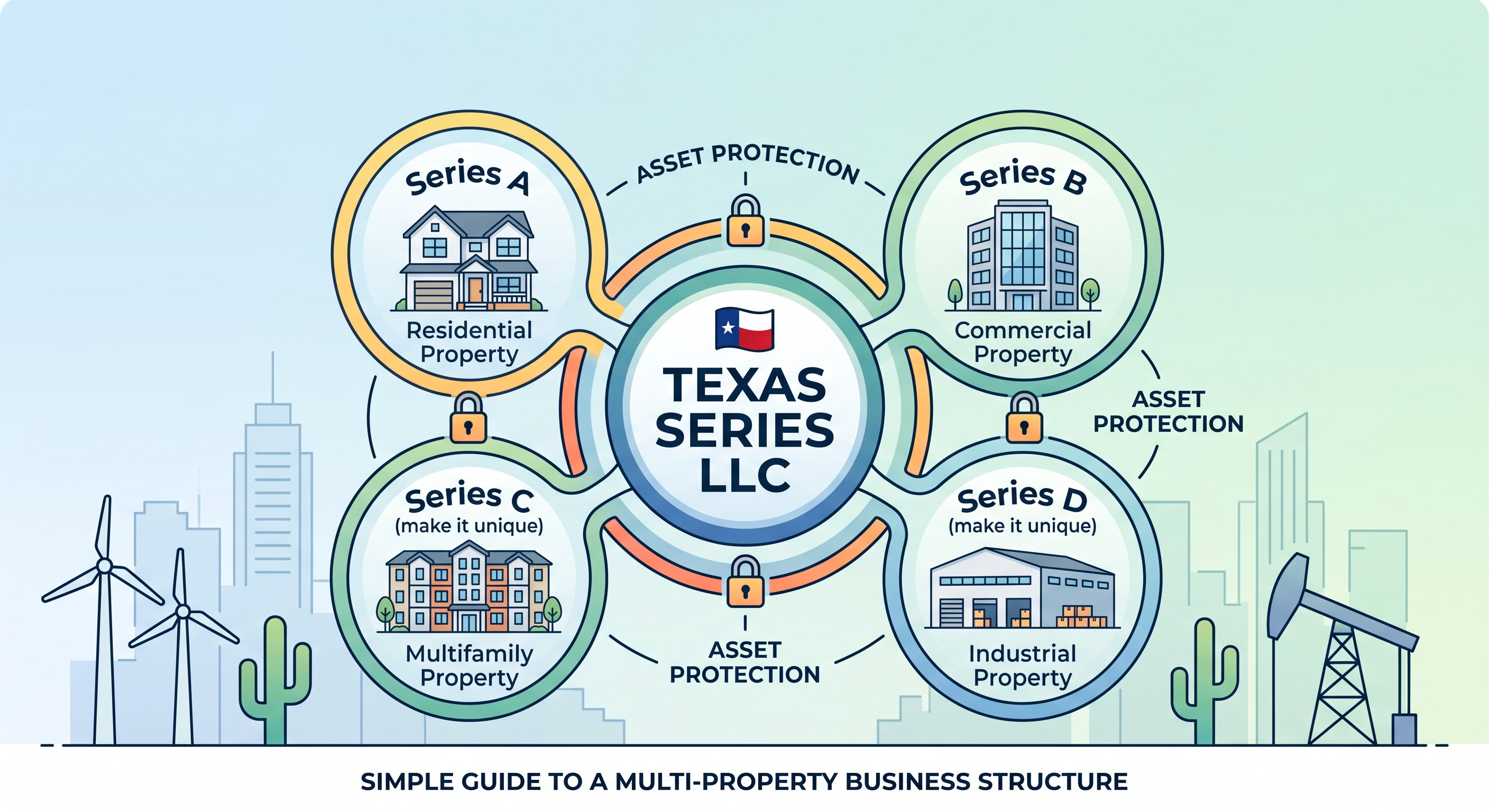
Every landlord eventually asks the same question. If a tenant sues over something that happens at one property, can they reach the equity in my others?
With everything held personally, or all in one LLC, the answer is generally yes. The traditional fix is a separate LLC for every property, which works but gets expensive and administratively miserable fast.
Texas offers a middle path that most investors in other states do not have. It is called the Series LLC, and for a landlord building a portfolio here, it is worth understanding.
How it works
A Series LLC is a single parent LLC that can create multiple internal divisions, called series, each functioning as its own liability compartment.
Put Property A in Series A, Property B in Series B, and so on. Under Texas Business Organizations Code Section 101.602, debts and obligations tied to one series can generally only be enforced against that series' assets, not against the parent LLC's general assets or any other series.
A slip-and-fall claim at Property A cannot reach Property B. That is the same protection you would get from forming separate LLCs, achieved inside one entity.
Under Section 101.605, each series has real legal capacity. It can sue and be sued in its own name, acquire and sell real estate, and grant security interests in its own assets. This is not merely a bookkeeping convention.
The cost math
This is where the structure earns its reputation.
A Texas LLC costs $300 to file with the Secretary of State, plus a small online convenience fee. A Series LLC costs exactly the same. The state does not charge more for the capability.
Since 2022, Texas recognizes two kinds of series:
Protected series are created entirely within the company agreement, with no separate Secretary of State filing and no additional state fee. The certificate of formation has to contain language authorizing series creation.
Registered series additionally require filing a certificate of registered series with the Secretary of State, at $300 per registered series. Registered series get a public record of existence, which some lenders and title companies prefer.
So for a landlord with five properties, the alternative structures are: one ordinary LLC holding all five, where a claim against one exposes the equity in all five; or five separate LLCs, meaning five filing fees, five franchise tax filings, five sets of records, and five registered agents.
The Series LLC aims at the middle. One filing, one umbrella, one registered agent, with each property walled off internally.
The tax treatment
The Texas Comptroller treats the entire Series LLC as a single taxable entity. It files one franchise tax report and one Public Information Report under the parent LLC's taxpayer number. The individual protected series do not file separately.
The no-tax-due threshold is measured at the level of the whole Series LLC, and for the 2026 report year that threshold sits at $2,650,000 in annualized total revenue. Reports are due May 15.
Worth noting that under Business Organizations Code Section 9.251, passive ownership of property without more does not by itself trigger certain filing requirements.
Where the structure fails
Here is the part that matters more than any of the above, because this is where people lose the protection they thought they bought.
The liability shield is conditioned on your recordkeeping. Section 101.602(b)(1) makes the entire asset-protection framework contingent on each series maintaining records that account for its assets separately from the parent LLC and from every other series.
That means, in practice: a separate bank account for each series. Separate books. Clear documentation of which property belongs to which series. Deeds and leases executed in the correct series name.
Commingle funds, run everything through one account, or sign a lease in the wrong name, and a plaintiff's attorney will argue the series were never genuinely separate. If that argument lands, the walls come down and you have one big LLC with one big exposure.
This is not a set-it-and-forget-it structure. It is a discipline.
The other real risks
Cross-state recognition is uncertain. Roughly twenty states authorize Series LLCs. California, New York, and others do not. If you own property outside Texas, or might, do not assume another state will honor the internal walls.
Title companies vary. In Texas, most title companies know how to handle a deed to "Series A of XYZ Series LLC" because adoption here is established. That is not universal.
Insurance carriers vary. Some landlord carriers issue a separate policy per series, some use named-insured riders, and some will not work with the structure at all. Sort this out before you rely on it.
Due-on-sale clauses. Most residential mortgages allow the lender to demand full repayment if title transfers, including a transfer into an LLC. Moving a financed property into any entity carries this risk, and it deserves a real conversation with your lender rather than hoping nobody notices.
Insurance is still your first line. No entity structure substitutes for adequate liability coverage. The LLC is the backstop, not the plan.
Who it actually fits
A Series LLC makes sense for an investor building a genuine Texas portfolio, several properties or more, with the discipline to maintain separate records, and ideally with an attorney setting it up correctly.
It makes less sense for someone with one rental, where a single LLC plus good insurance is simpler and adequate. And it is not a do-it-yourself project for high-value assets, because the structure only delivers if it is built and maintained properly.
Where we come in, and a useful advantage
Most agents who write about entity structures leave you to go find someone who can actually build one. We are in a different position.
Our broker, Michael MacFarlane, owns North Houston Compliance Advisors, a company that forms Series LLCs and handles related entity work for clients. That means the gap between understanding this structure and actually having one set up correctly is considerably shorter for our clients than it is for most investors, who typically spend weeks getting referred around.
In the interest of being straightforward with you: North Houston Compliance Advisors is owned by our broker, so we have a business relationship to disclose. We think that is an advantage rather than something to bury, because it means the people helping you acquire property and the people helping you hold it properly are actually coordinated. But you should know the connection, and you are under no obligation to use them.
We are a real estate team, not attorneys or CPAs, and this is general information rather than legal or tax advice. Your specific structure deserves professional guidance, and the tax treatment is a conversation for your CPA.
Whatever structure you land on, the other half of the equation is ours: finding properties in Montgomery County that work as investments, negotiating the acquisition price that makes the numbers function, and putting investors in front of inventory worth owning. The best entity structure in Texas cannot rescue a bad buy.
Call or text 713-303-5039.
The Keegan Group | Montgomery County, Texas / Residential · Commercial · Land · Investment · Property Tax Consulting.
More in Investment

2026-09-25
The First Tuesday Foreclosure Auction in Montgomery County: How It Actually Works
Every first Tuesday, properties change hands at auction across all 254 Texas counties. How it works in Montgomery County, the two different auctions people confuse, and an honest look at whether you should bid.
2026-09-25
Timber Valuation and Hunting Land in East Texas: The Tax Treatment Landowners Should Understand
On wooded East Texas acreage, timber valuation can turn a five-figure tax bill into something far smaller. How it works, the wildlife management alternative built for hunting land, and the rollback tax that blindsides buyers.

2026-09-25
Short-Term Rentals on Lake Conroe: The Rules, the Numbers, and the Real Risk
Montgomery County has no county-level STR ordinances, which makes Lake Conroe unusually owner-friendly. But the real risk is not the government. It is your HOA covenants, and most buyers never read them.
Ready to Discuss Your Needs?
Whether you're locally upgrading, relocating to the area, or expanding your business or investment portfolio, we're here to guide you with competence and precision.
Call or Text: 713-303-5039