Cash or Leverage in Rental Investing: The Sliding Scale Between Cashflow and Appreciation
Five leveraged properties often produce less spendable income than one owned free and clear. Cash and leverage are not two options, they are endpoints of a scale, and the middle is where a lot of good outcomes get built.

The standard advice in real estate investing is close to religion. Use leverage. Put as little down as possible. Control as much property as the bank will allow. Anyone paying cash for a rental is leaving returns on the table.
That advice is not wrong, exactly. It is just answering one question while most investors are asking a different one. Here is the more useful way to think about it.
The two things a rental can give you
A rental property produces returns through several channels, but two of them dominate, and they pull against each other.
Cashflow is the money left in your pocket every month after the property pays for itself. It is income, it is spendable, and it arrives whether or not the market does anything.
Appreciation is the growth in the asset's value over time, amplified enormously by leverage. It is not spendable until you sell or refinance, and it depends on the market cooperating.
Leverage buys you appreciation exposure at the direct cost of cashflow. Every dollar of debt service is a dollar that used to be income. That is the entire trade, and once you see it clearly, the question stops being cash versus leverage and becomes which of those two things you actually want.
The cashflow case for cash, with real arithmetic
Take a simplified example. Assume $250,000 of capital, properties around $250,000 each, and rent around $2,200 a month. These are illustrative numbers, and yours will differ, but the structure holds.
Buy one property with cash. Gross rent runs about $26,400 a year. Subtract property taxes, insurance, maintenance, capital reserves, vacancy, and management, which in Texas realistically consume a large share of gross rent, and you are keeping somewhere in the range of $12,000 a year.
There is no mortgage payment. Every dollar the property clears after expenses is yours.
Or buy five properties at 20 percent down. Now you control $1.25 million of real estate with the same $250,000. Gross rent is five times larger, around $132,000. But your operating expenses are also five times larger, and now you are also servicing roughly a million dollars of debt.
At today's investor rates, that debt service alone runs in the neighborhood of $80,000 a year or more. Run the whole equation and the leveraged portfolio frequently produces thin, breakeven, or negative cashflow.
That is the part the conventional advice glosses over. In the rate environment we have lived in for the last several years, five leveraged properties often generate less spendable income than one owned free and clear. Sometimes considerably less. Sometimes they generate a monthly bill.
So if your objective is income, and specifically income you can live on, cash is not a compromise. It is frequently the better answer by a wide margin.
The leverage case, stated fairly
Now the other side, because it is genuinely powerful and it deserves an honest hearing.
That leveraged investor controls $1.25 million of real estate instead of $250,000. If property values rise 4 percent in a year, the cash buyer gains $10,000 and the leveraged buyer gains $50,000, on identical capital. That is the whole argument, and it is a strong one.
On top of that, five tenants are paying down five mortgages, so principal reduction builds equity every month without costing the investor anything. And as we have written about elsewhere, fixed-rate debt gets repaid in dollars that lose value over time, which means inflation quietly works against your lender and for you.
Compound that across a decade and leverage builds substantially more net worth than cash does, provided two conditions hold: appreciation actually materializes, and you can survive the years when the properties are not paying you.
That second condition is where leveraged investors get hurt. A portfolio running at breakeven has no margin. One extended vacancy, one major repair, one insurance increase, and you are funding the portfolio out of your own pocket. Do that at the wrong moment and you become a forced seller, which is how leverage turns from an accelerant into a wipeout.
It is a scale, not a switch
Here is the reframe worth taking from all of this. Cash and leverage are not two options. They are the endpoints of a continuum, and you get to choose where on it you stand.
At one end, all cash: maximum income, minimum risk, minimum appreciation exposure, smallest footprint.
At the other end, minimum down payment: maximum appreciation exposure, maximum risk, minimum current income, largest footprint.
And there is a great deal of useful territory in between that almost nobody talks about, because nothing obligates you to put exactly 20 percent down.
Put 40 percent down and you control two and a half times the real estate while keeping meaningful cashflow. Put 50 percent down and you get a genuinely durable position: real appreciation exposure, real income, and enough coverage that a vacancy is an inconvenience rather than a crisis.
That middle territory is where a lot of conservative investors quietly build very good outcomes. You give up some appreciation upside in exchange for a portfolio that pays you and does not keep you up at night.
The option value of cash, which is the underrated part
This is the argument that gets least attention and may matter most right now.
You can always add leverage later. You cannot easily remove it.
Buy a property with cash today, and if rates improve in two or three years, you refinance and pull capital out on terms you chose. Meanwhile the property has been paying you the entire time you waited.
Buy that same property at 20 percent down in a high-rate environment, and you are locked into that payment. Yes, you can refinance later, but you spend the intervening years with thin or negative cashflow, no reserves accumulating, and no flexibility if something goes wrong.
Cash is not just a way to own property. It is a way to preserve your options while the environment changes. The investor sitting on paid-off, cash-flowing property in a high-rate market has every move available to them. The overleveraged investor in the same market has one move: hold on and hope.
The operational argument nobody puts in the spreadsheet
One more, and it is real even though it never shows up in a return calculation.
One property means one tenant, one roof, one HVAC system, one set of turnover costs, one relationship to manage. Five properties means five of everything, including five times the phone calls, five times the maintenance coordination, and five times the odds that something is going wrong on any given week.
Scaling a portfolio is a business, and businesses take time and attention. For an investor whose goal is reliable income rather than empire building, the difference between managing one free-and-clear property and five leveraged ones is a genuine quality-of-life return. It is worth something, even if it does not appear on a spreadsheet.
So where do you belong on the scale?
Ask yourself these honestly.
Do you need income now, or wealth later? If you are retiring, replacing income, or funding a lifestyle, weight toward cash. If you are thirty-five with a strong W-2 and a thirty-year horizon, leverage has more time to work.
How much volatility can you actually absorb? Not theoretically. Actually. If a six-month vacancy plus a roof replacement would genuinely hurt you, you are overleveraged at 20 percent down.
How much do you want to manage? Be honest about your appetite for being a landlord across multiple doors.
What do reserves look like? Leverage without reserves is not a strategy, it is exposure.
And what do you believe about this market? A heavier appreciation bet makes more sense in a corridor with real population and job growth, which Montgomery County genuinely has, than in a market that is flat.
There is no universally correct position on this scale. There is only the one that fits your situation, and the investors who get hurt are almost always the ones who adopted someone else's position without checking whether it matched their own circumstances.
Where we come in
Whatever position you take on that scale, one thing does not change: the acquisition price determines whether any of it works.
A cash buyer who overpays has locked up capital in a mediocre asset. A leveraged buyer who overpays has locked up capital in a mediocre asset and taken on debt to do it. Buying well is what makes every version of this strategy function, and buying badly is what breaks all of them.
That is our end of it. We know Montgomery County block by block, from Conroe and Willis through Magnolia, Montgomery, Spring, and Tomball, and we help investors find properties that genuinely perform and negotiate the number that makes them work. We are also RES.NET certified and work directly with banks on bank-owned inventory, which is frequently where the below-market acquisitions that improve any structure come from.
We are a real estate team rather than lenders or financial advisors, so the financing and portfolio decisions belong with you and your professionals. What we bring is the deal.
If you are weighing how to deploy capital into rentals here, let us run real numbers with you on real properties rather than talk in generalities.
Call or text 713-303-5039.
The Keegan Group | Montgomery County, Texas / Residential · Commercial · Land · Investment · Property Tax Consulting.
More in Investment
2026-09-25
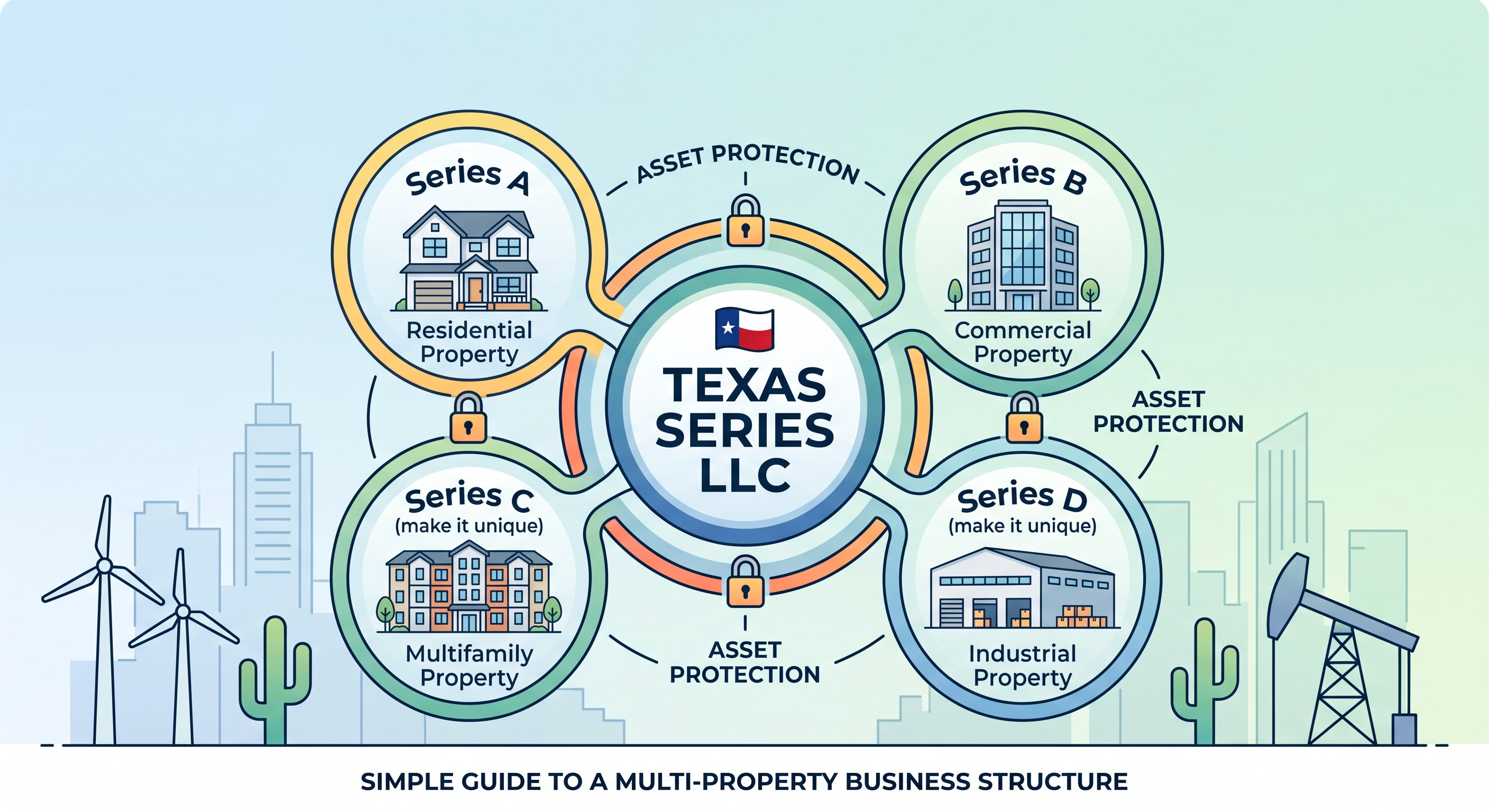
The Texas Series LLC: The Asset Protection Structure Built for Landlords
If a tenant sues over one property, can they reach the equity in your others? Texas offers a structure most states do not: the Series LLC. How it works, what it costs, and the recordkeeping discipline it demands.

2026-09-25
Short-Term Rentals on Lake Conroe: The Rules, the Numbers, and the Real Risk
Montgomery County has no county-level STR ordinances, which makes Lake Conroe unusually owner-friendly. But the real risk is not the government. It is your HOA covenants, and most buyers never read them.

2026-09-25
The First Tuesday Foreclosure Auction in Montgomery County: How It Actually Works
Every first Tuesday, properties change hands at auction across all 254 Texas counties. How it works in Montgomery County, the two different auctions people confuse, and an honest look at whether you should bid.
Ready to Discuss Your Needs?
Whether you're locally upgrading, relocating to the area, or expanding your business or investment portfolio, we're here to guide you with competence and precision.
Call or Text: 713-303-5039